
Chapter 7: What's the Story?
My apartment, all 250 square feet of it, was the earth.

“People are not taking this seriously,” Angelika said, sipping her Moroccan Mint Julep. We were waiting for our couscous, hummus, and Kefta Kebab. Café Mogador was packed and buzzing. Slummers fueling up, downloading stories bouncing in their heads, it was all so fabulous and out of reach. We sat at the same table as we did on our first date. Angelika just came from the gym. It was good to see her sharp and alive, with color in her cheeks. “It’s hugely important. Maybe the most critical thing in the world. We don’t have the earth, we don’t have anything. Can’t we all agree on that?”
I shook my head and agreed that we should all agree with that. Absolutely. The Earth was important.
Angelika complained about her pre-planning meeting with the Environmental Action Coalition. Earth Day organizers are not thinking big enough, she said. In April, activities were primarily localized along College Walk at Columbia, with smaller activities in other communities. The turnout was sparse, and the energy was low.
It was a far cry from 1970, the first Earth Day, when Union Square and Fifth Avenue closed, and 100,000 people in New York rose for Mother Earth. Interest in the environment waned in the 80’s. There were enough problems to occupy us right here, right now. The earth I trod was paved, and I traveled in a steel projectile underground. If I were lucky, the sun would peek between two six-story buildings and stream in the window for a half hour. That was the extent of my natural environment.
To compensate, I arranged houseplants in my apartment to evoke a sense of the jungle and connect with living matter. A spider plant and philodendron hung in corners from macrame holders. Succulents, a Boston fern, peace lilies, and cacti lined the windowsills to catch brief direct sunlight. Every day, I surveyed the plants and cleaned their leaves, top and bottom, to protect them from spider mites and dust. I talked to the plants because I read that they respond to the human voice. I lay next to the plants sometimes, and I was transported beyond the apartment, absorbing oxygen from them and breathing the loamy, damp soil. I cruised the flower district on Sundays, the streets lined with foliage. I’d spend a couple of hours before deciding on the perfect plant. I lovingly arranged the rubber plant and Chinese evergreen around the room until I settled on the perfect Feng Shui. I reserved a shelf for the little brass water sprayer, soil amendment, and clay pots for my urban houseplant jungle. My apartment, all 250 square feet of it, was my earth.
“So, what will you be doing?” Angelika asked.
“Good question,” I said. I told her about the study and how I was going to offer it to Barney at the Times. Facilitating the flow of information, promulgating a story, or suggesting puzzle pieces that, if properly interlocked, could lead to a story I was not yet aware of.
“Disgusting. Fucking developers,” she said. “We can use good PR for Earth Day.”
I said yeah, of course. It would be an honor to do pro bono PR for Earth Day. I didn’t tell her about Myron’s book. It was too embarrassing. She called the neurocryogenic story creepy and weird. I agreed and let it go. I made sure not to tell her that this mysterious company, Trigon Properties, was planning an Earth Day announcement next April about ... ?
“How’s your sister?” I asked.
She closed her eyes briefly, and when she opened them, her face was a mask.
“Better,” she said. “She’s getting help. Therapy. Medication. It’s been hard on both of us.” I breathed. It’s all I could do, and I tried not to let a wave of guilt overwhelm me. I thought I could mute my fractured family by finding a useful role in Angelika’s fractured family, but I was not prepared for the tragedies of her mother’s cancer and her sister’s suicide attempt. The relationship was comfortable for a while; it relieved the pressure of drama-filled, short-term bursts of attraction and repulsion that characterized my relationships since, probably, the day of my birth. There was comfort with Angelika, her sister, and her mother at the family home in New Jersey. My querencia, my power spot, and my comfort zone were in the LaZBoy recliner in front of the TV, in charge of the action with the remote control. Nothing neutralizes you like a stroll through a New Jersey mall. And then we had to deal with the dying cat.
I brought Alice, the female tabby, into our relationship, and she brought Henry, the male. They bonded like a tight couple. We couldn’t bear to break them up, so we shared custody. She had the cats for a few months. Then, she’d pack them in their carriers and cab them down to me, and I’d have the cats for a while. Those were the terms of our divorce, so to speak. Joint custody. We broke up like adults, and that felt like progress.
Alice started ailing around the same time Angelika’s mother entered the final stage. Feline leukemia. Drawn out and fatal. Angelika tended to Alice like a patient: she prepared an IV drip twice a day and probiotics as often as she could, sometimes every hour. She was holding onto Alice for dear life, and she was holding on to and letting go of her mother, and I didn’t know what to do. I hadn’t processed the death of my father enough to help Angelika through her tragedy, and it all blew up.
For two years, we shared an apartment on Avenue B and Third Street, me, Angelika, and the cats, in a new building that was a gentrified incursion into the LES. Rent was cheaper than uptown, and we had more space, an elevator, and a roof garden. We were responsible for the heating bill. It was a new building, and the heating system was obviously faulty. We spent insane amounts of money every month, and the apartment wasn’t heated. I organized a rent strike and convinced all twenty-six tenants to participate - mostly young, adventurous white people who wanted to live in the grunge and razor-edge creativity of LES with a modicum of modern comfort. At first, everybody liked the idea of a rent strike because they thought it meant you didn’t pay rent. When it became clear that we were withholding rent until the landlord fixed the heating system, but we didn’t stop paying rent, I had to deal with disgruntled tenants complaining to me, the de facto landlord who collected monthly rent checks. The one who listened to excuses for why they’d be late with the rent.
The landlord was unyielding and tried to blame the tenants for misusing the heat, a ridiculous argument that resulted in a stalemate, adding another level of stress to an impossibly stressful life. I was obsessed with bringing the landlord to justice, and, along with personal tragedies, it accelerated our breakup. We gave up the apartment and went our separate ways. I looked at places outside the city, but it wasn’t doable. My body wouldn’t accept living outside New York. Beyond intellectual rationalization, it was visceral. Out there, beyond the borders of New York, I was breathing alien air, and people behaved strangely, like they weren’t fully formed. I got a studio on East 12th Street, a few buildings down from Allen Ginsberg and Peter Orlovsky. How many times, stumbling past Ginsberg’s apartment from King Tut’s Wah Wah Hut, or the Pyramid Club, did I treat Angelika to a theatrical rending of the opening of “Howl.”
I saw the best minds of my generation destroyed by madness, starving hysterical naked,
dragging themselves through the negro streets at dawn looking for an angry fix,
“I’m dating,” she said. Dating means sex, and that felt like a dagger to the heart of one of our big issues. Although it was a shock, I was happy for her. She was a good person, and she deserved to be appreciated. Maybe I wasn’t ready for a good person.
“Who?” I asked.
“A guy,” she said.
That’s all I was going to get. She had her own story, and she was making it clear that I wasn’t part of it. A guy.
“And you?” she asked.
“Nothing serious,” I said.
True enough. Seriously, nothing was going on in my life, except work.
“You read about the hearings?” she asked.
The New York Times and the Washington Post covered the two days of hearings chaired by Senator Gaylord Nelson on the greenhouse effect and depletion of the ozone layer. Scientists said that the oceans were warming, and the polar cap was melting. We were told to expect temperatures higher than at any time in the past 100,000 years. Expect ecological havoc and more skin cancer due to the thinning ozone layer. The Wisconsin senator was an ardent environmentalist and the founder of Earth Day. He spoke wisdom in a sentence. “The economy is a wholly owned subsidiary of the environment, not the other way around.”
Reagan’s science adviser dismissed the dire warnings as “unnecessarily alarmist.”
“Do you even care?” Angelika asked.
I shrugged. My capacity to care about anything beyond my immediate sphere was diminishing and approaching extinction. It was sad seeing Angelika. So much loss, so many severed connections. So much I couldn't take in because my mind was cluttered with work.
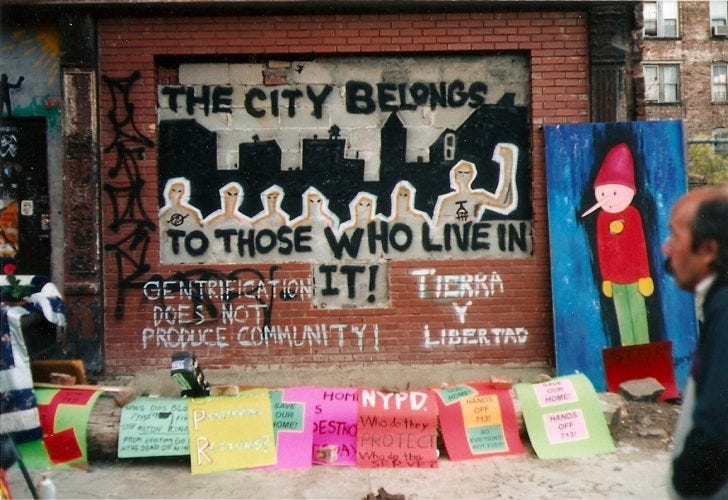
Nigel was peeing into jugs because there were no toilets at Bullet Space. I didn’t want to ask where he was defecating, or about the rats or roaches. He cruised Chinatown for pallets and the East River under the Brooklyn Bridge for driftwood to feed into “the big pig,” a wood burning furnace that kept them warm through last winter when they sledgehammered their way into the abandoned tenement at 292 East 3rd Street, between Avenues C and D. They were anarchists and artists, original squatters who occupied abandoned buildings owned by the city, and declared by their presence that they were solving the housing crisis with their sweat and toil, so go fuck yourself.
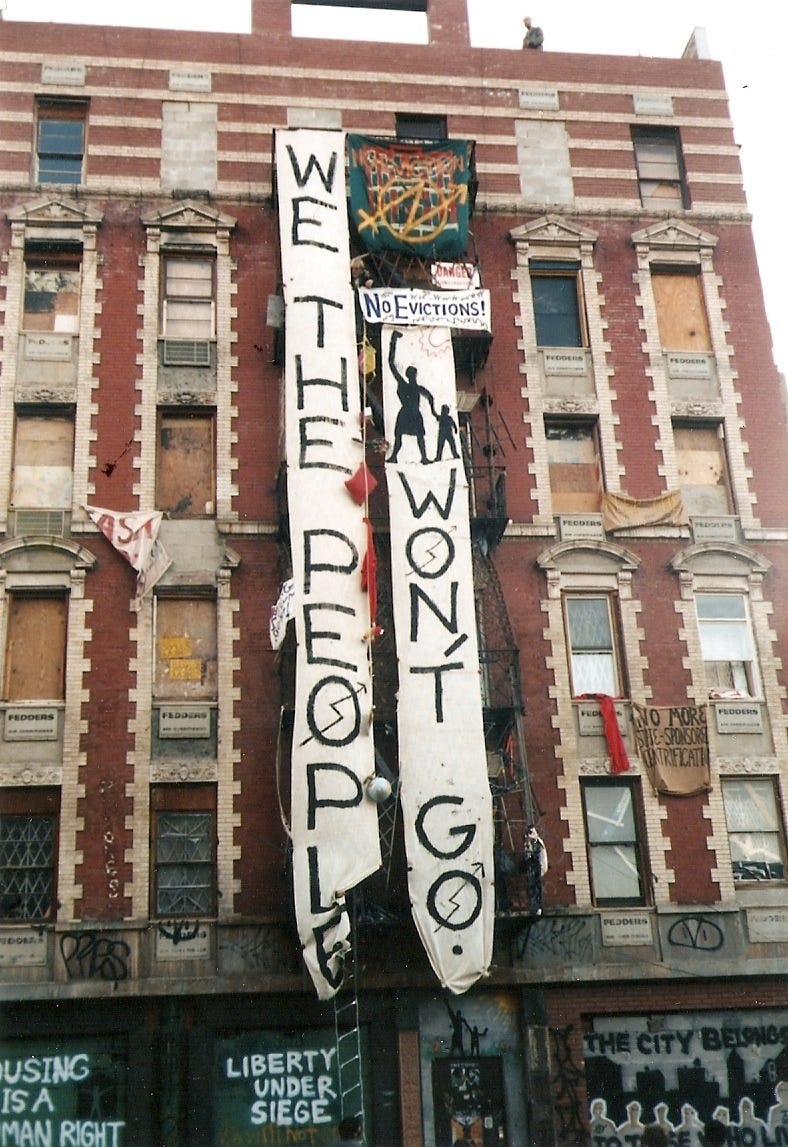
Bullet Space, a pre-law tenement built in 1867, was named for the Bullet brand of heroin that sold freely on the block in front of the five-story squat. Nigel was living art, living his art, acting on his beliefs. He was guided by “The Gita,” as he called the Bhagavad Gita. Chapter 17, Verse 3: “A person is made by their belief. As they believe, so they become.” He was a gentle soul, always glad to see me.
We sat at the end of 7B, at Vazac’s Horseshoe Bar, the ultimate dive bar, a cinematic, alcohol-soaked cauldron that encompassed the full range of humanity, from a businessman in a suit to a biker to a squatter. That afternoon, Nigel got a bowl of free matzoh ball soup from Abe Lebewohl at the 2nd Avenue Deli. Abe, a Holocaust survivor, was legendary for feeding artists and writers in the neighborhood, and I was one of them. Abe liked stories. He was a talker and a listener. He established the Yiddish Walk of Fame, brass stars embedded in the sidewalk in front of the Deli, as a testament to the thriving Yiddish theater that once defined 2nd Avenue south of 14th Street.
There was always someone to buy Nigel a drink at the Horseshoe. He was tired from a day of demo and hauling scraps from the building to the abandoned lot next door, and his new girlfriend, whom he loved because he could shower at her place anytime, sometimes with her, was expecting him that night. He discovered something new, and he was excited to tell me about it. “Drywall,” he said, like it was the secret to his life.
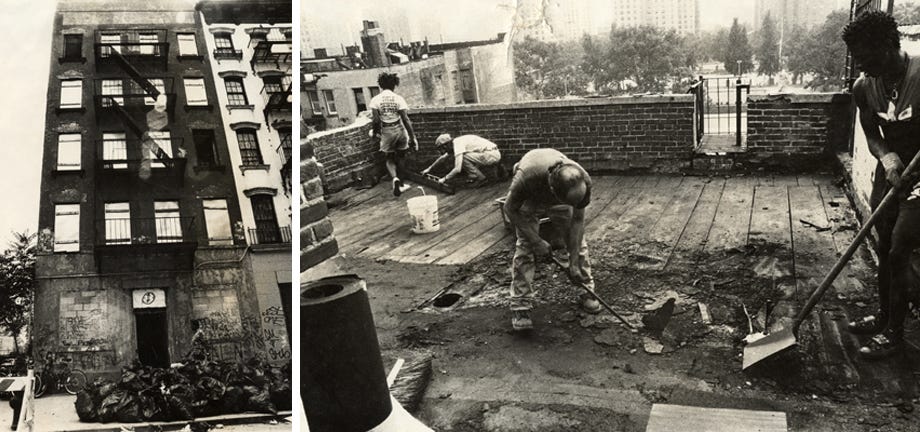
On the down low, he shared that they had pirated an electricity feed, as they do in Beirut, and that he could now read by a lightbulb instead of a candle. He was developing his own code of hieroglyphics in fine ink drawings, which he would contribute to the next art show at Bullet Space. You gotta come, he said to me, and I did. “How can you exist like that?” I asked Nigel, and he looked at me like he didn’t know what I was talking about. “Remember this, my friend, all stories in New York lead to real estate,” he said, and we clinked beer mugs.
On the walk from Café Mogador to the Horseshoe, I passed Die Yuppie Scum spray-painted on the side of an abandoned building, more than once, in my face, as somewhere buried not too deep, I considered that $1,000 a month studio in Battery Park City, pristine and protected and anonymous, as a reward for my new status as an upwardly mobile professional climbing out of this fetid neighborhood.
Stay tuned next Wednesday for Chapter 8.
See all chapters of What’s the Story?
words words words website with all stories: markbrose.substack.com
Friends: If you like this story, please take a moment to give it a “Like.” That’s the heart icon you see at the top and bottom of the story. Substack operates on algorithms, like any social media. The more likes and comments I get, the wider my readership. Grazie.
Great writing about a New York most of us don't know about. And shared custody cats.